Platform
BeacenAI is a deterministic two-plane architecture: the Control Plane governs stateless Execution Plane runtimes that regenerate instead of persist.
The BeacenAI Platform
Traditional infrastructure assumes machines persist. State accumulates. Configurations drift. Credentials linger. Humans intervene. At scale, that operating model becomes fragile and expensive.
BeacenAI replaces persistence with regeneration. Operating environments are composed from policy, verified at runtime, and rebuilt when conditions change—so the system stays deterministic instead of decaying over time.
Execution Plane
The Execution Plane is the runtime substrate. It delivers stateless, policy-bound execution environments across enterprise and AI workloads.
It does not “fix” drift. It eliminates drift by rebuilding clean execution from verified policy. No accumulated state. No long-lived credentials. Deterministic runtime.
Control Plane
The Control Plane is the policy authority and orchestration intelligence. It continuously evaluates identity, posture, network conditions, mission requirements, and geography.
From that evaluation it composes the exact runtime required—nothing more—and enforces it continuously. When conditions shift, it instructs regeneration. It does not patch decay.
One System. Two Planes.
Intelligence lives in the Control Plane. Security boundaries live in the Execution Plane. Together they produce infrastructure that scales without multiplying administrative burden—and adapts without accumulating risk.
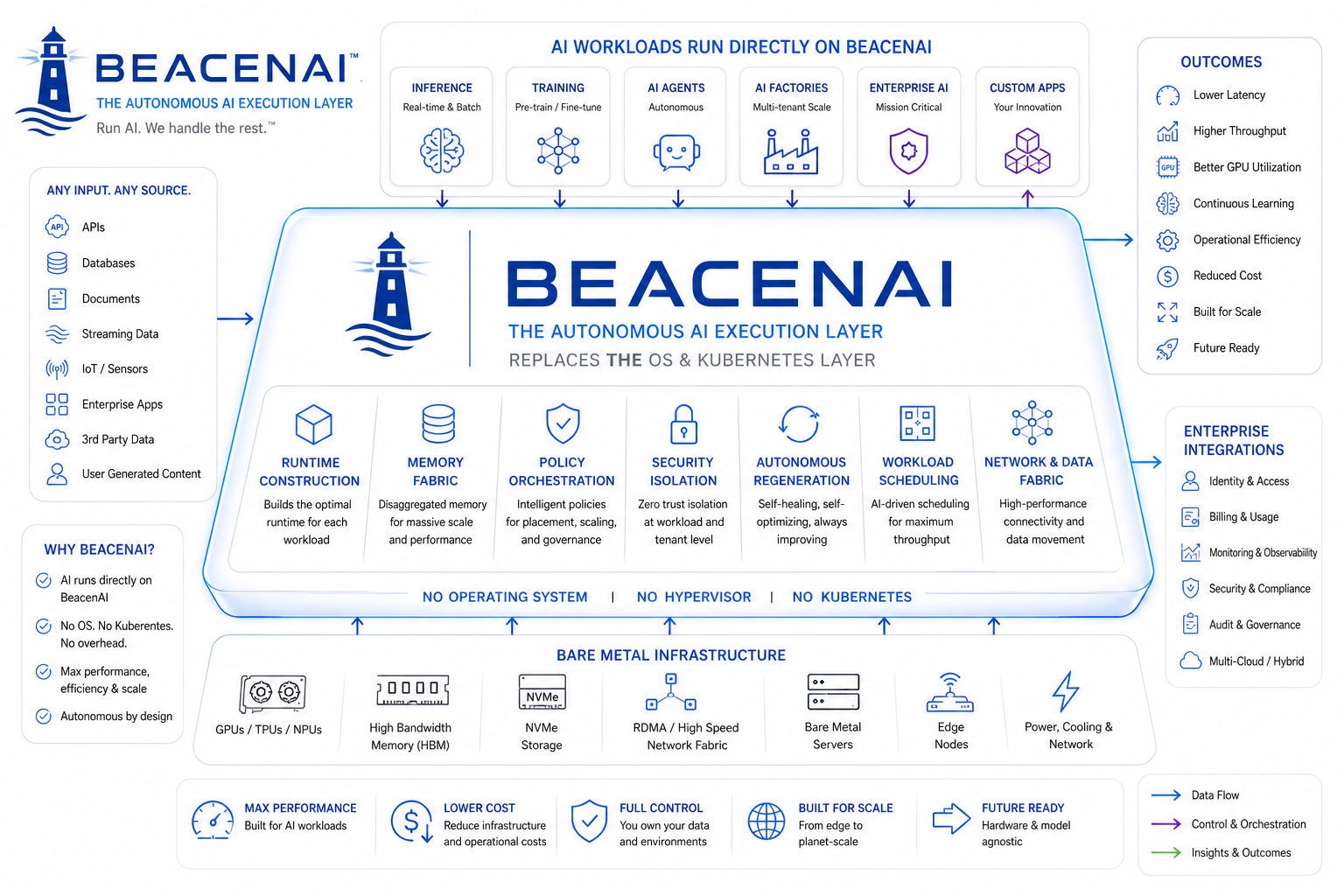
Available now — built and refined over more than three decades. Not a concept. Not a roadmap. Not vaporware. Proven under real operational constraints where drift, downtime, and manual intervention are not acceptable.
Platform Components
Two parts. One operating model. The Control Plane governs intent. The Execution Layer delivers deterministic runtime.
Go Deeper
If you want the full narrative and the system design, start here.


Want a fast, technical walkthrough?
Tell us your environment (enterprise, AI workloads, data center, edge) and the constraints you can’t compromise on. We’ll map how the Control Plane and Execution Plane compose a stateless execution layer in your stack.